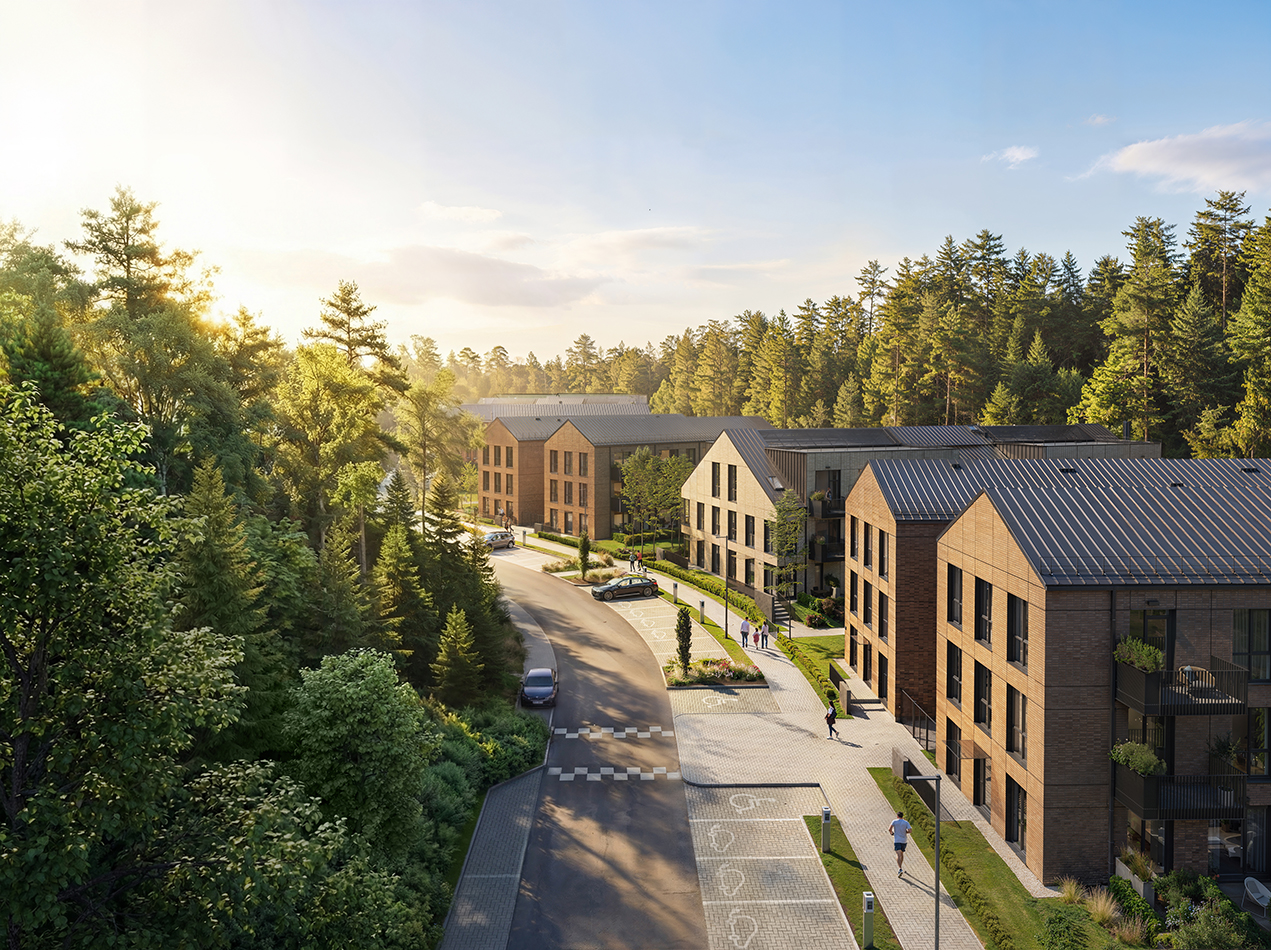
The Mosso residential quarter, currently under development in Vilnius’ Burbiškės Forest Valley, is rapidly taking shape. The main structural works have now been completed in the low-rise residential development, with just 14% of apartments still available for sale. Stronger demand than in most residential projects across the capital reflects a broader global housing market trend: urban residents are increasingly seeking well-being through closer proximity to green spaces.
Surrounded by forest, the Burbiškės neighbourhood has long remained one of Vilnius’ hidden gems. Today, it is emerging as one of the city’s most distinctive new residential locations. Real estate developer Galio Group is creating a modern living environment in the area through the Mosso project. In its first phase, the development introduced 165 apartments across six low-rise residential buildings.
“Within just 10 months of construction commencing, 142 apartments have been sold in the Mosso project, leaving only 23 units available. This level of demand significantly exceeds the average sales rate across Vilnius’ new-build housing market. During this period, Mosso ranked among the five most sought-after residential developments in the city,” says Eglė Šimkienė, Head of Sales at Galio Group.
“Buyer activity confirms a growing trend observed across European cities: access to green surroundings supports healthier lifestyles, and proximity to nature is playing an increasingly important role in housing decisions.”
According to the 2024–2025 European Residential Investor Survey conducted by international real estate consultancy Knight Frank, urban green spaces are now among the four most important priorities for homebuyers across Europe. Residents increasingly view green spaces as an essential part of residential infrastructure that supports well-being and quality of life. This shift in buyer behaviour is driven not by fashion or prestige, but by growing attention to personal health.
Recent climate and public health challenges—including heatwaves and the COVID-19 pandemic—have prompted numerous scientific studies demonstrating that urban green spaces help cool cities, improve air quality and reduce noise pollution. Studies have also shown that regular time spent in nature can help slow biological ageing, while stress hormone levels decline significantly even after a short walk in the forest.
Exceeding the “3-30-300” Benchmark
The well-being sought by today’s homebuyers is increasingly defined by a specific scientific concept known as the “3-30-300” rule, which has become a widely recognised principle in modern urban planning.
According to this framework, every resident should be able to see at least three trees from their window, live in a neighbourhood where tree canopy covers at least 30% of the area, and have access to a park or green space within 300 metres of their home.
Professor Cecil Konijnendijk, one of the world’s leading experts in urban forestry and the originator of the rule, describes it as the minimum standard required to support both physical and mental health in cities.
“The 3-30-300 rule is increasingly viewed as the benchmark for modern urban development. In residential projects such as Mosso, being developed in Burbiškės Forest Valley, residents can step outside their front door and find themselves in a genuine forest setting. The Paneriai Erosional Hills Landscape Reserve is located nearby, while all the advantages of city life and essential social infrastructure can be reached within minutes by car,” says Šimkienė.
According to Galio Group’s Head of Sales, buyers recognise that a forest setting is a limited and highly valuable resource. As a result, the project in Burbiškės is viewed not only as an attractive place to live but also as an investment with strong long-term value retention potential. Its unique natural surroundings and the scientifically proven benefits of nature on quality of life are expected to support property values over time.
“By closely monitoring and analysing sales in the primary residential market, we clearly see that over the past ten months in Vilnius, the highest levels of buyer demand have been recorded in projects located within or adjacent to natural environments. Apartments in these developments are selling faster than elsewhere, and this trend continues to gain momentum,” Šimkienė notes.
A Real Forest Right Outside the Door
The Mosso quarter is being developed on a unique site spanning nearly five hectares. The area’s distinctive rolling terrain was formed by retreating glaciers and remains one of its defining natural features. According to Galio Group, the natural setting has significantly influenced the architectural concept, leading to the decision to develop low-rise buildings of just three storeys that integrate harmoniously into the surrounding landscape.
The neighbourhood’s infrastructure has been designed to prioritise safety and tranquillity. A traffic-calmed internal street will run through the development alongside pedestrian pathways and recreational areas. Private bicycle storage facilities will also be installed, allowing residents to conveniently access the forest trails that begin immediately beyond the development.
The entire project is planned to be delivered in three phases. The first phase, designed by DNA Studio and AIF LT, comprises six residential buildings with a total of 165 apartments. Unit sizes range from 27 to 76 square metres, with prices starting from EUR 115,000.
The first residents are expected to move into their new homes by the end of 2026.